My Father, My Contextual Text Ad

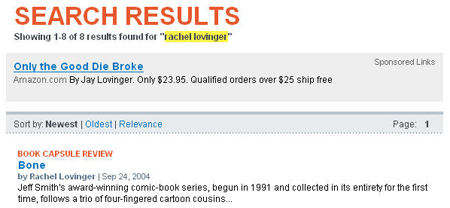
I used to work for the website of a national entertainment publication. Although my primary job was related to content management, metadata strategy, and site development, I occasionally wrote articles and reviews for both the site and the magazine. I was talking to someone today and wanted to show them one of the articles I had written, so I went to the site and typed my name into the site search.

 Search Results

The new design of the site includes a contextual text ad right at the top of the results. I was amused to discover that the ad that’s most closely related to a search for articles written by me is a link to Amazon for a book by my dad. I know that this is just a result of the fact that there are no entertainment products containing my name, plus the fact that “Lovinger” is a statistically improbable last name, but I still thought it was a wonderfully serendipitous example of related search results.

Designing Information at IxDA

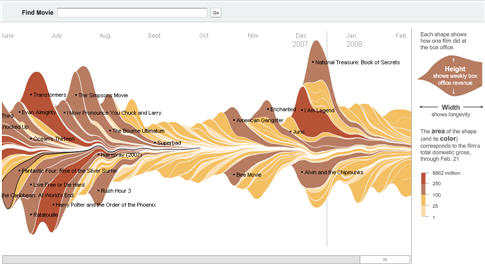
Two of my colleagues, Anh Dang and Nirali Patel, are going to be speaking at a conference called IxDA Interaction 08 in a few weeks. We recently had a preview of their presentation, called Designing Information. I don’t want to give too much away, for those that may be attending the conference, but I really enjoyed hearing about it because it converged nicely with my own interests.

The aim of their talk is to discuss their point of view on how to present data in a way that’s meaningful – not just cool or interesting looking. There are some sites that present really beautiful infographics, but they don’t necessarily tell you anything. More suitable for hanging on the wall than for providing illuminating knowledge or understanding. I think that’s just wasteful.

I’m not a designer, myself, so in my line of work I generally collaborate with someone who is. Ideally, I bring insight on the full range of data and the story that it wants to tell, and the IA or designer has the tools and techniques to make that story come to life. Anh and Nirali have a great perspective on the thought processes, insights, and strategies needed to make those techniques really work, and I’m glad to see them contributing their ideas to the discussion.

Some things get better, some get worse…

A couple months ago, I wrote a post about disinformation architecture in Facebook apps. Recently I noticed that the app had been improved in some ways. For one thing, you don’t get interrupted quite as often and asked to invite your friends. When you do have the opportunity to invite friends, the “skip” button is now a lot more prominent, like so: 

Skip Button on Flixter Quiz

Unfortunately, they couldn’t leave well enough alone. Continue reading “Some things get better, some get worse…”

Creative Commons is not “carte blanche”

recent Pew report states that 47% of Americans have looked themselves up on Google or some other search engine. I like to practice a more specific form of vanity search – I use a couple of blog search sites to see where my flickr photos have been used. All my photos are posted under a “by-nc” Creative Commons license which states that they can be reused for non-commercial purposes, provided that I’m giving credit for the image.

I’d like to point out that I’m not doing this vanity search to check up on people, I just really enjoy seeing how my photos are used. It’s fun to see my images of celebrities, New York landmarks, comedians, or even something as mundane as cherry blossoms adorning someone’s blog post. Generally the authors attribute the photos to my screenname and link back to the originals on my flickr account. Some people even get in touch with me and ask for permission beforehand, though that’s not required with the CC license. I don’t really even pay much attention if the site has Google ads, even though, strictly speaking, that qualifies it as “commercial” usage.

There’s still the occasional shock, though, and the latest one is so deeply ironic I can’t really even comprehend it. I discovered a photo I took of the IAC building that was used, without any attribution at all, on a website called paidContent.org. Despite the “.org” in the name, this is clearly a commercial website. On the page that contains my photo, I counted 16 ad spots, 3 sponsored channels, and 3 calls to action to “ADVERTISE ON PAIDCONTENT.” On top of that, the article is about a Pre-Conference Reception being held by paidContent.org at the IAC building, and it features a prominent button inviting readers to buy tickets to the conference (plus 8 additional links to sponsors of the conference). So, not only is my photo being displayed on a commercial site, but it’s directly being used to promote the sale of tickets to an event (well, it was – the event is now in the past).

The most troubling part about this is that these are not people who can claim ignorance. This issue falls right in their area of expertise, which according to their site is “global coverage of the business of digital content.” Plus, their own website is published under a “by-nc-sa” CC license, which means it has the same restrictions as my photo, but also that if you reuse the content, you can only do so under the same license (in other words you can’t put their content into your own work and then copyright it).

Although, maybe they don’t understand Creative Commons as well as I would expect them to, because right under the message that says “This work is licensed under a CreativeCommons License.” there’s another message that says “Copyright ContentNext Media Inc. 2002—2007.”

Being, as I am, a Content Strategist and a consultant, paidContent.org seems like it would be exactly the type of organization that would appeal to me. But this experience makes me question how they could possibly claim to be experts in the field of digital content.

Semantic Technology Conference 2007 Recap

I suppose it’s very old news, but I recently stumbled across this short recap I wrote of STC07 last summer. I didn’t publish it here at the time because I thought it was going to be used elsewhere. Since that doesn’t look like it’s going to happen, I figured I’d post it now in honor of those submitting proposals for Semantic Technology Conference 2008. Due date for proposal submission was today.

Continue reading “Semantic Technology Conference 2007 Recap”

OpenID and the Social Graph

First, full disclosure: I don’t know a lot about OpenID. But I do know that there are some serious issues related to online identity. Here are two of the questions I find most pressing:

  1. How do I create a persistent identity, across all the different web services I use? This is a question of convenience. Registering for a website that I’m going to use once is kind of ridiculous. Even if I wanted to use it again, chances are I will have forgotten my password, or even that I ever registered there in the first place. I could always register again, but that isn’t useful for me, or the service provider.
  2. How do I take ownership of my personal information? This is a privacy and security question. I’m online a lot. There’s a lot of digital information about me that could be gathered up to paint an interesting picture of who I am. Ideally, I should be the person who owns that picture and controls who has access to it.

Now, I’m not saying that OpenID has solved these problems – far from it – but it has created the opportunity for people to test things out and discuss what works and what doesn’t. As far as I can tell, the first issue is being addressed more directly than the second. Still, I don’t think we’re going to have a meaningful approach to the privacy question until we get some more experience with persistent identities.

Continue reading “OpenID and the Social Graph”

My Facebook Status is… Meta

I love checking the status of all my Facebook contacts. I do this whenever I’m bored or need a distraction. I can check them on my phone, so proximity to a computer isn’t a requirement. And, since categorizing things is what I do, I’ve noticed some patterns.

Types of Facebook Status

(Note: All examples are completely made up. Any similarity to any of my Facebook buddies is purely coincidental.)

  1. Cryptic – no one knows what your status means, but it shows off your creative and/or mysterious side. Ex: Rachel is indefatigable.
  2. TMI – sometimes people don’t need to know what you’re up to. Ex: Rachel is getting drunk and going home with strangers.
  3. Inside Joke – only a few people know what your status means, everyone else is saying “huh?” Ex: Rachel is missing blue boy, already.
  4. Meta – you’re breaking down the fourth wall. Ex: Rachel is checking Facebook on the train.
  5. Mood-based – describes how you’re feeling. Ex: Rachel is bored.
  6. Activity-based – describes what you’re doing. Ex: Rachel is shopping.
  7. Location-based – describes where you are. Ex: Rachel is in Washington.
  8. Health-based – describes your physical or mental state. Ex: Rachel is coughing, again.

These types are not mutually exclusive. Someone’s status can be TMI and Activity-based. But everyone’s status fits into at least one of these categories. Want to know the breakdown of the 65 status updates of my Facebook contacts? Continue reading “My Facebook Status is… Meta”

Two Semantic Webs

I was reading this post by Nova Spivack when I finally understood that there are two semantic webs. Nova calls them The Intelligent Web and The Data Web. (I think this is in some way related to the longstanding debate about Semantic Web vs. semantic web, which never really made any sense to me before). To put a slightly different spin on it, I like to think of these as the Orderly Semantic Web and the Chaotic Semantic Web.

Continue reading “Two Semantic Webs”